NATASHA GINWALA / ARCHIVE OF LIMITS
Colombo, originally made in 2020,
reviewed in 2025
Natasha Ginwala is a curator, researcher and writer, co-curator of Sharjah Biennial 16 (2025), and artistic director of Colomboscope, Sri Lanka since 2019. She recently concluded her role as associate Curator at Museum Rietberg’s Collection of Indian Miniature Painting Large at Gropius Bau, Berlin (2018 – 2024). She was also artistic director of the 13th Gwangju Biennale with Defne Ayas (2021). Ginwala moved to Berlin in 2013 to join the artistic team of the 8th Berlin Biennale for Contemporary Art. Further, she has been part of curatorial teams of Contour Biennale 8, documenta 14 (2017), Taipei Biennale (2012) and curated several international exhibitions including at e-flux, Sharjah Art Foundation, Hamburger Bahnhof – Museum für Gegenwart, ifa Gallery, KW Institute for Contemporary Art, L’ appartement 22, Muzeum Sztuki w Łodzi, MCA Chicago, 56th Venice Biennale, SAVVY Contemporary and Zeitz MOCAA. From 2013–15, in collaboration with Vivian Ziherl, she led the multi-part exhibition and research project Landings presented with several partner organisations. Ginwala is a widely published author with a focus on contemporary art, visual culture, and social justice.
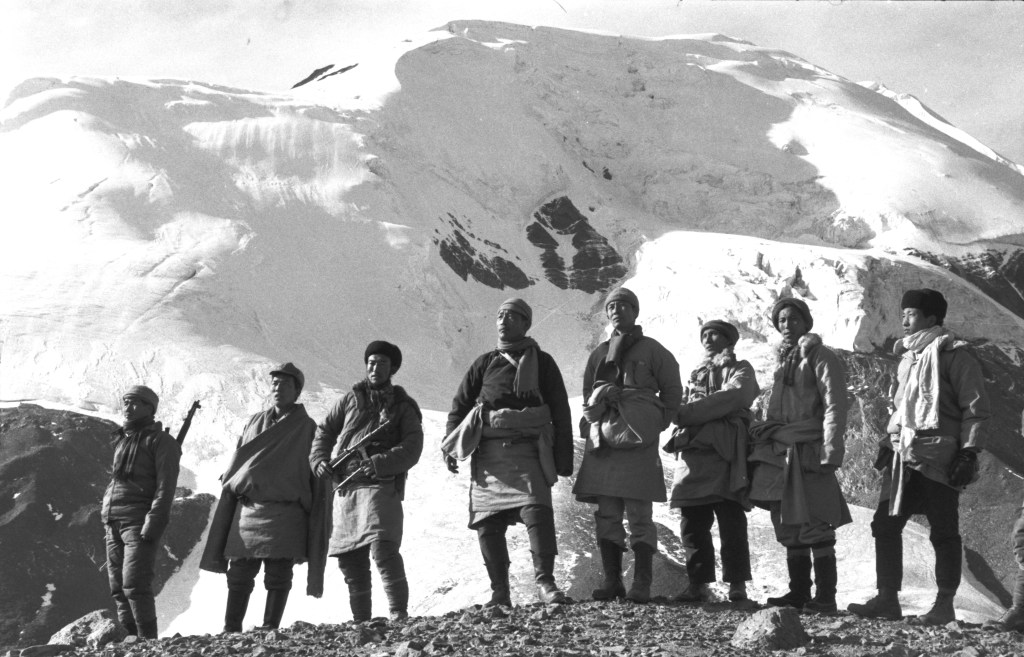
Photo Lhamo Tsering Archive / White Crane Films.
Courtesy Ritu Sarin and Tenzing Sonam
I WOULD LOVE TO START THE CONVERSATION WITH YOUR OWN DEFINITION OF ARCHIVE. OF COURSE, DEFINING THINGS ALSO EXCLUDES OTHER INTERPRETATIONS, BUT IT WOLD BE REALLY INTERESTING TO HAVE YOUR PERSONAL POINT OF VIEW ON THE QUESTION. HOW DO YOU, AS A CURATOR, POSITION YOURSELF TOWARDS THIS SUBJECT, AND WHAT IS THE RELATION THAT YOU HAVE WITH IT?
The curatorial archive for me is an active space. It’s an active space that exists outside of practices. I would like to give you very specific examples of how I used archival material from the beginning of my work. I would like to start by speaking about the notion of an archive of limits. As a curator, what we often are up against is the forces of forgetting, of an amnesia at an institutional level – that is not only a cultural institution, but also a social institution, right? So, what does it mean then, to work and respond and stretch those limits of representation? The notion of the archive is something that I choose to activate within the exhibition scenarios and that admits forms of dialogue. Sometimes there have also been presentations of archival content that have come up during programming. So, it’s not only for the static space of the exhibition, but also as a part of the live process, for me. The one thing that I felt when I started to practice as a curator internationally, was also this moment of, (or a kind of rush), of digitization. Suddenly museums, libraries were putting out high resolution, digital images, books and maps out of a frequency that we had not witnessed before. My practice is circumscribed within that rush, inviting archives in the digital space. I took that as a critical starting point for my curatorial work and decided that from the earliest exhibition that I have made, there would be some way to filter this access, because it seems democratic, it suddenly seems like “Okay, everything is available.” Even more during the pandemic: the world is locked and suddenly there is even more that you can actually consume. I’m really thinking about what it means to deal with archives and how my relationship with them has also really changed my practice. Some of the work using archives also goes into my writing. I often illustrate my essays with historical images. I studied Islamic and Persian Miniature Painting in Delhi. Suddenly, it was after I finished studying and while I was working that I noticed even more an availability to zoom into the miniature form and really circulate and explore it in a way that you can not do with the miniature painting in front of you at a museum. I really started to consider these images particularly from this tradition of art history. One way of using them for me has been, for instance, to write an essay about the anthropocene using Islamic miniature paintings, a new way of reading images from well known collections in the world like the Seckler Gallery’s. In terms of exhibition making, one of the early collaborative projects was with Vivian Ziherl, where we started looking at early geological images, to study the modern history of extraction and trying to understand how early geology connects to the time of the Anthropocene, and at the same time trying to understand the colonial positioning of this discipline. So again, the archive was a key to bring out documents and, of course, inviting contemporary artists; but at the same time, working with these archival contents, with early maps, with images from the photographic archive of the Tropenmuseum, for instance, as we were in Amsterdam. We thought about how geologic imagery had been cultivated under colonial regimes and had dictated our consciousness toward planetary relations today. That was another way in which archival material was always present with an exhibition form and writing. I have also been interested in fiction and imagined archives, so to stretch the terminologies or realities of what is an archive and how do you perform an archive into being. So, one of the projects is the Museum of Rhythm, which is a project that I have done twice in different institutions and that doesn’t exist on its own. In that case, the making of that speculative institution, the Museum of the Rhythm, also has archival quality to it, because it comes into being and disappears and it is up to me, in a way, to make it real again. I like playing with those boundaries as well.
WHAT I UNDERSTAND, IS THAT FOR YOU THE ARCHIVE IS MORE LIKE A PROJECTION OR AN IDEA THAT YOU CAN USE, THAT YOU CAN MANIPULATE USING DIFFERENT KINDS OF MEDIA, ALSO CURATORIAL ONES.
Yes, I have been in this constant journey, in a way, of bringing out what is residue, what is a fragment, what is left over. Those categories I think we need to destabilize, we need to then recommit a narrative with those materials. It’s also not about me possessing particular objects or documents. It’s about bringing them into circulation.
I WOULD LIKE TO HEAR ABOUT WHAT YOU BRING INTO THIS RESEARCH: NOT SOMETHING THAT YOU POSSESS, BUT THAT BELONGS TO YOU, SOMETHING THAT IS VERY PERSONAL TO YOU AND THAT IS PART OF YOUR ARCHIVE, OF YOUR MEMORY.
I’m not sure where to start with that, because I also read in some of your previous interviews that a lot of curators declare that they don’t necessarily organize and keep up a personal archive.
THAT THEY DON’T HAVE AN ARCHIVE, YES.
For me one of the things that I enjoy doing is buying old books, first edition books. Of course I also use the digital, I usually have folder preference images that have been taken from the Internet and that are from various collections and libraries. And everytime I start a project, I usually develop that kind of system, storing mostly found historical documents, materials. For me, that is the core of the kind of knowledge system that I want to develop with each project.
OK, SO BOOKS AND ARCHIVES INFORM YOUR RESEARCH. HOW DOES THIS END UP BEING PHYSICALLY PRESENT IN THE EXHIBITION? DO YOU DISPLAY THESE OBJECTS IN YOUR EXHIBITIONS?
Absolutely. In every project, there has always been a physical display. In every single project. I’m constantly working with those contents and bringing them into circulation. You make them contemporary, you make them relevant and you start to converse with them again.
CAN WE TALK ABOUT THE DISPLAY THEN? BECAUSE I’M REALLY INTERESTED IN THIS QUESTION, AND ALSO A BIT WORRIED BY THE TRADITIONAL DISPLAY OF ARCHIVAL MATERIAL: YOU HAVE A FACT PROVIDER THAT ADDS VALUES TO THE ARTWORKS OR CONTEXTUALIZES IT, AND IT’S DISPLAYED HORIZONTALLY IN GLASS BOXES LIKE FORENSIC EVIDENCE. I’M TRYING TO UNDERSTAND IF THERE IS ANOTHER WAY, A MORE SUBTLE ONE PERHAPS, TO PUT THE ARCHIVE INTO CIRCULATION, AS YOU SAID.
The thing is we always say “Okay we want to reject the vetrine”, but then, of course, there are certain conditions and when you have an original document you’re bound to contain it. I don’t like the idea of just using some cheap reproduction, because the materiality of that historical work coming out of the storage is gone, in that way. I like a challenge, for instance, wrestling with the museum, for permission, I like the process of debating also why they should release these items from the storage and why they should be able to start a dialogue with them. So for me the process of display has been more about mapping out certain relationships. Even if we end up using a certain kind of vetrine or shelves or something to hold that item, I always try to find and create some kind of tension, and to be speculative, to destabilize what is a given museum label, and to turn the narrative into something completely different. When you are looking at it, you know you already feel other possible readings. That has been crucial to me. For instance, in the 8th Berlin Biennale, there was a section I did called Double Lives, in which I looked at certain colonial protagonists, who were administrators and scientists of that time, but they were all formed by imperialism. They ended up going on these expeditions and administering territories, part of their collections or archive ended up going to the National History Museum, the British Library, the Ethnographic Museum, so that one person’s belongings that they rooted or documented, all of these things were completely scattered. When I was trying to exhibit them, I actually was borrowing from all these sources and they didn’t know what the whole picture was, because they had really divided it up into all the different disciplines. I was actually trying to look at it as a whole. I think exhibitions also make them animate and they reconstruct meaning in terms of display. I wanted to mention one more example: in Korea, I came across these two private museums: they are basically the collections or archives of individuals, who are experts in folk painting, in shamanism, Confucianism. For the Gwangju Biennale, Defne Ayas and I decided to keep very open and see also what caught our attention, but actually very soon during our research we came upon books by an anthropologist called Laurell M. Kendall who was referring to this very small museums in Seoul; a shamanism museum and the Gahoe Museum of Folk Painting. We tried to track these museums down and when we went there, we realized that they are basically the collections of two individuals. They have built this kind of universe of thousands of very important items that reveal the legacy of Korean shamanism and the pre-christian traditions that have existed there in visual culture and that are still very important to our practice today. So it is an archival collection, but it is also a gathering of items from the shamanism museum that can be used in ceremonies. Some are very recent so it is also about material culture. Again, archive and display become a part of a ceremony in this case. In that case, it is not about the vetrine, but about you seeing items that are charged, they are amulets, they are decorations that are made during the ceremony.
IT SEEMS THAT THERE IS NO BOUNDARY AT ALL FOR YOU BETWEEN THE NOTION OF ARCHIVES AND COLLECTIONS, AN IDEA THAT I I AM REALLY FOND OF. WHEN YOU SPEAK ABOUT THE COLLECTIONS OF THESE PRIVATE MUSEUMS, YOU REFER TO THEM AS ARCHIVES…
I think in this case they are kind of, because they are really made by these individuals. It is different then if it is a state museum, I wouldn’t call it an archive. But in this case, it’s also a referential tool set. These are items that are really meant to be repurposed, they are meant to be generative, to give you information. That’s where I feel that there is a blurred line between the collection and the archive.
THE KNOWLEDGE PASSES THROUGH THE PHYSICAL OBJECT, SO REALLY THE COLLECTION AND THE ARCHIVE ARE THE SAME THING AT THIS POINT. WHEN YOU WERE REFERRING TO THE DISPLAY OF ARCHIVES BEFORE, YOU WERE MENTIONING HISTORICAL OBJECTS AND HISTORICAL MANUSCRIPTS, FOR EXAMPLE, AND I WANTED TO ASK YOU: WHAT IS THE TEMPORAL DIMENSION OF THE ARCHIVE? IS IT THE PAST? OR WE CAN ALSO SAY THAT WHAT IS HAPPENING RIGHT NOW BETWEEN YOU AND ME, THIS CONVERSATION FOR INSTANCE, IS ALREADY AN ARCHIVE, IN A WAY? KNOWING ALSO THAT FROM THE MOMENT WE SAY SOMETHING MEANS THAT IT IS ALREADY IN THE PAST, BECAUSE IT TAKES A WHILE BETWEEN THE MOMENT WE SAY SOMETHING AND THE MOMENT WE REGISTER IT. ONCE THE INFORMATION IS REGISTERED, IT IS ALREADY PAST. SO DOES THE PRESENT ACTUALLY EXIST AND CAN WE REALLY LINK THIS THINKING TO THE ARCHIVE?
I think that is a really good question. Also because I have been thinking about that a little bit more for myself as time changes, as our time gets even more authoritarian and repressive, once I start to think much more about neo present and how certain aspects that are remaining under the surface that are pushed, suffocated to the extent that they cannot reveal themselves as living knowledge. That is what we need to tend to: an archive that is kept relevant and kept in conversation with. It is a matter of urgency. Right? So I am asking myself a lot of questions about this. Actually, a project that I worked on with Bonaventure Soh Bejeng Ndikung, in fact, was called The Shadow Circus: The CIA in Tibet (1998). It was an exhibition that we first did at Savvy Contemporary and it is realized with Ritu Sarin and Tenzing Sonam. They are filmmakers, an Indian and a Tibetan couple, who have been working on the Tibetan freedom struggle and Himalian geography and migration of the Tibetan community since many years, more than two decades. I have been working with them for a couple of years now, but for this project, we were looking at the archive of Tenzing Sonam’s father, called Lhamo Tsering. They were documents about the guerrilla fighters in Tibet between the 50’s and 60’s till the 70’s and the CIA. Both of us, myself and Bonaventure, were amazed by the depth of this particular personal archive, it’s a kind of family archive in a way as well. Because it was not allowed to exist. That again, for me, this is the question of an archive of limits. The fact that this material is not allowed to exist, for it contains very sensitive material, is continuing Chinese repression. It’s an archive that is already at a public level, something that has been censored, so we need to work with it curatorially in a very intelligent way, so that we can make sure these materials are set up as an example for a struggle that is still ongoing, it is unfinished. We don’t want it to be seen as “Oh this is in the past, they look like heroes.” This is one chapter where the story is continuing. At the end, we did go through the archive, we brought in the exhibition materials from the archive. There was a very special exhibition architecture that was created for that show, there was an intimacy and you were able to see something that is not allowed to be public. I just feel like adding one last thought about what could be an archive without images. Because I personally have been so stuck with the visual form. I have this obsession with finding images, nowadays also finding excerpts from poetry that I saved up as notes so that I can go back to. But in order to really challenge myself, the idea of an archive without images came to me when I worked with the artist Sissel Tolaas, who works with smell. She has a smell archive and smell library with a thousand smells. That really hit me and made me realize what an archive can do. When she came to Sri Lanka and she started to document the smell from the coastline and she came back to the city and we were smelling, it was such a visceral, such a bodily experience. How can we create that immediacy, that complete satisfaction? Maybe images can really be mental images, because physical images of the archive are actually in the smell. So I found that was really special.
IT IS REALLY CHALLENGING TO IMAGINE WHAT AN ARCHIVE CAN BE TODAY. IT CERTAINLY IS NOT AN ARCHIVE THAT WE ARE USED TO, YOU KNOW, THE OFFICIAL ARCHIVE, THE CONSERVATIVE POWER KEEPING ARCHIVE THAT WE GROW UP WITH, ESPECIALLY IN THE WEST. I THINK THAT THERE ARE A LOT OF NOT ONLY THINKERS, BUT ALSO STRUCTURES AND INITIATIVES THAT ARE CHALLENGING THIS NOTION. I ONCE MET AN ARTIST, A CANADIAN-BORN ARTIST WORKING IN RENNES, JULIE C. FORTIER. SHE WAS WORKING CLASSIFYING SMELLS AND SHE HAD A LITTLE LAB WITH ALL THESE SMELLS… IT WAS SUCH A MYSTICAL EXPERIENCE. YOU RECONNECT THE SCENTS TO MEMORIES THAT YOU HAD THAT ARE NOT PRESENT IN YOUR MIND, SO YOU HAVE TO RE-CHANNEL THAT MEMORY, RE-SPOT IT SOMEHOW, LIKE THE SMELL OF THE BLOOD. THAT WAS VERY EMOTIONAL TO ME. I REALLY WENT BACK TO MY CHILDHOOD SOMEHOW, IN THAT LAB. I THINK AN ARCHIVE CAN ALSO BE A WAY TO TRIGGER NOT ONLY MEMORY BUT ALSO FANTASY. THANK YOU VERY MUCH FOR BRINGING THESE REFLECTIONS UP.

