KRISTINE KHOURI
RASHA SALTI
EXHIBITION AS ARCHIVE IN THE MAKING
Beirut and Berlin, originally made in 2020,
reviewed in 2025
Kristine Khouri is a researcher whose background is in Arab cultural history and art history. Her interests focus on the history of arts circulation, collection, exhibition and infrastructure in the Middle East and North Africa as well as archival practice and knowledge dissemination. Most recently she has been focused on critical engagement with digital archives/digitized collections and issues that emerge from them including rights, access, and language. Khouri is a member of the board of the Arab Image Foundation, Beirut. Rasha Salti is a writer, researcher, and curator of art and film. She has cocurated several film programs, including Mapping Subjectivity: Experimentation in Arab Cinema from the 1960s until Now (2010–12), with Jytte Jensen, at the Museum of Modern Art (MoMA). She was one of the cocurators of the tenth edition of the Sharjah Biennial in 2010. Khouri and Salti are researchers and curators of Past Disquiet, a long-term research project that began in 2008 and was transformed into a documentary and archival exhibition that has been exhibited internationally since 2015 and are coeditors of Past Disquiet: Artists, International Solidarity, and Museums in Exile (2018).
IT MIGHT BE USEFUL TO START WITH YOU TWO PRESENTING YOUR COLLABORATION, NAMELY THE HISTORY OF ARAB MODERNITIES IN THE VISUAL ARTS STUDY GROUP, BEFORE WE START DISCUSSING PAST DISQUIET.
Kristine Khouri: Rasha and I met in 2008, we were living in Beirut at the time, and shared an interest in research around the history of modern art in the region. The larger context was the emergence of new museums and institutions in the Gulf, that were producing new narratives around the region’s cultural history and history of art, but these museums did not seem to have a sufficiently complex knowledge of modernity. We were really interested in looking back to the 1950s, 1960s, and 1970s, not at specific artistic practices, but rather, the social and cultural history of art, asking questions along the lines of: When did people start hanging art on their walls? How did art galleries come about? How did artists show their work outside galleries? How were they educated? What kinds of publications were circulating at that time? What types of conversations were taking place between cultural practitioners, intellectuals, poets, filmmakers and visual artists? We conducted several interviews, with art critics, gallerists and artists who also were cultural practitioners, or were actively involved in artist unions. We were also very interested in exhibition histories, and it was during an interview with a seminal art critic, Joseph Tarrab, that we learned when the Lebanese public might have seen “modern art” for the first time. Known as the first “Musée imaginaire in Lebanon and the Orient”, the exhibition was held at the UNESCO palace in Beirut in 1957. It basically consisted of photographic reproductions of works deemed “canonical” of modern (western) and eastern art, a UNESCO-led and sponsored program to acquaint the non-western world with “modern art”. We dug into its history, and when access to archives proved challenging we had to rely on people’s memories. Eventually we wrote a text that we presented at conferences and that was eventually published in a collection of texts around rethinking the art history of the region entitled Speak, Memory (Townhouse Gallery, Cairo, 2010). After that, we found the catalogue for the International Art Exhibition for Palestine, and that was the starting point of out major project, Past Disquiet. In 2007, 2008 and 2009, there were a number of scholars who were completing their PhDs primarily at American universities on the history of modern art in the region, focusing on Iraq, Egypt, Syria, Palestine and Lebanon. This new generation of researchers and scholars were expanding the field and were engaged with them.
Rasha Salti: Those years were often described as witnessing “museum fever” in the region, almost entirely in the Gulf, while the so-called reference scholarship on the history of modernity was unsatisfying because the prevailing paradigm was very conservative and did not consider social history or anthropology. The emerging scholars that Kristine is referring to, were conducting novel and exciting work and we could sense that they were bringing about a major turn in the art history of the region. The story of the“Musée imaginaire” exhibition of reproductions in 1957 came up after we asked Joseph Tarrab a simple question: when might Lebanese people have seen “modern art” for the first time? And by ‘people’ we meant a general audience (i.e. not an expert or specific audience predisposed to a keen interest in art). We also asked him detailed questions around the mechanics of the emergence of galleries and an art market, how galleries determined prices, and how or when people felt compelled to buy art. Basic questions that were entirely absent from prevailing narratives of art history at the time. The International Art Exhibition for Palestine was an extremely intriguing story, and the exhibition’s catalogue in our hands was our only “trove of clues”. With regards to archives, the situation in Lebanon during the Civil War and in Palestine, is very different in contrast to Egypt and Syria. The institutional archives that exist in Lebanon are very difficult to access, however more generally, the culture of archiving (a practice eminently attached to the state) was not as rigorous or diligent as in Egypt and Syria, obviously the Civil War was also a deterrent, or a constraining factor. And for Palestinians, whether under occupation or in the diaspora, the practice of archiving could not be sustained or systematic. Questions of archive are effectively questions of transmission. The transmission of memory, knowledge, expertise, an official narrative and a counter narrative. When the civil war ended, we were supposed to rebuild the country, and the question of transmission became as crucial as the question of memory. In my opinion it was one of the reasons so many active practitioners in the cultural field are interested in archives. The International Art Exhibition for Palestine basically intersects the two realities of the situation of archives in Lebanon and in Palestine, it’s like a double drama.
KK: And trauma.
RS: Precisely. There are several books on the history of the PLO (Palestine Liberation Organization) in Lebanon, but very few address cultural practices. Meanwhile, the number of films, magazines, posters produced in that period, the PLO’s patronage, attest to the importance of culture for the PLO. A closer look shows how the struggle for Palestinians’ rights manifested itself in myriad and captivating ways through the contribution of artists and cultural workers. The International Art Exhibition for Palestine was on the one hand shrouded in mystery and forgetting, and on the other hand, when it was present in the recollections of those who remembered it, it was embedded in a troubled, unsettled remembrance. The first challenge was to motivate people to accept revisiting this past. The second challenge was fact checking. Mona Saudi, the exhibition’s custodian, was reluctant to speak to us and allow us to consult her own archives. Other people who were very closely involved in the exhibition behaved in the opposite manner, they availed themselves repeatedly (and tirelessly) and opened all their personal archives to us. Eventually, we learned that researching a recent past in a present moment that lacks resolution, was a situation not specific to Lebanon only, we encountered it in Nicaragua and in South Africa to some degree. The conundrum of these unwritten histories was the fact of harkening back to a moment when the aspiration for liberation, for overthrowing dictatorship and achieving equality, swept our interviewees’ in a present world in a present moment when the struggle had either not achieved its promises, or seized power and become corrupt and unpopular. In other words, our interviewees were carrying the burden of disenchantment, disappointment and had either been marginalized or written out of the story as artists and cultural protagonists.
KK: Additionally, the narratives of that history are sites of contention, the Lebanese history textbooks stop at the year 1975, at the outset of the Civil War. In other words, there is no agreement on one version of the history of the war, and no accountability for those whose actions should have been indicted in a court of justice. So, narrating or writing histories of these moments is difficult. Furthermore, some archives, like those attached to the PLO, were destroyed during the war, specifically by the Israeli army.
RS: To cut a very long story short, we started from the exhibition catalogue. Our first step was very simple, we wanted to understand whom the artists listed in the catalogue were, whether they were still alive, and if we could contact them. Secondly, we studied the list of people acknowledged to have contributed to making the exhibition possible. Eventually we came to understand that the exhibition was the work of the group of people that had institutional support from the PLO, and that the ambition was to create a solidarity museum and that the exhibition was its seed collection. Shortly after, we came to understand that it was not a unique initiative, and that there were other liberation struggles that undertook similar initiatives in the same time period, namely, initiatives that mobilized artists, established collections and museums without walls that incarnated the solidarity of international artists with a specific cause. We chose to narrow down our research to four museums, that were concretely linked, and these were the International Museum of Resistance “Salvador Allende”, the Art Against/Contre Apartheid collection, the collection in support of the people of Nicaragua (after the Sandinista Revolution) and the collection in solidarity with the Palestinian people. The idea of a “solidarity museum” had currency in that time period, and was part of the global transnational, anti-imperialist front of solidarity.
RS: That front mobilized writers, visual artists, filmmakers, etc. We studied these four cases and the network of artists that was behind the collections and museums. The network comprised artist collectives that were active in staging happenings and events in public spaces, artists who organized exhibitions against the market; in other words, artists who identified with, endorsed or supported the front of transnational solidarity and anti-imperialist, anti-colonial struggles, between the middle of the 1960s and the 1980s.
KK: The catalogue –which we actually sourced in the library of Agial gallery in Beirut–, was the starting point of our research, and as we investigated the networks of artists involved. The more threads we uncovered, the more the horizons of the networks expanded. The struggle of the Palestinian people was the gateway and the lens -through which to look at the rest of the world. The exhibition that was imagined as a future museum was part of the history of radical museum-making that was happening at that time. The Palestinian struggle was part of a larger history of anti-imperial struggles, which grew out of the anti-Vietnam War movement worldwide mobilization, that eventually also included the rejection of the Pinochet dictatorship and the anti-apartheid movement.
THANK YOU FOR GIVING THIS VERY DETAILED OVERVIEW OF YOUR RESEARCH AND HOW IT UNFOLDED OVER THE YEARS.
HOW LONG HAVE YOU BEEN WORKING ON THIS ARCHIVE FOR, SO FAR? DO YOU FEEL IT IS CONCLUDED OR YOU ARE STILL WORKING ON IT?
KK: The research began in 2008, interviewing protagonists in Beirut, Damascus and Amman. It was not until 2011, after we met with French artist Claude Lazar in Paris, that the research took a drastic turn. When we went to meet him, as he received us at his studio and he said, “I have been waiting for you for 30 years.”. And thanks to his wife, Margot (also an artist), he had kept three boxes of archival material of what he had carried back from Lebanon, because he had traveled to Beirut carrying artworks for the exhibition in 1978. His archive ended up being a central part of our project. Were it not for him, it would have been very hard for us to visualize the exhibition. His recollections of that chapter opened up our research beyond looking at this one exhibition.
Is our research concluded? I don’t know. It feels hard to close or shut down this project. The different iterations of Past Disquiet, the exhibitions, feel like steps towards a form of closure. We have so far presented versions of the exhibition (and research) in Barcelona (MACBA), Berlin (Haus der Kulturen der Welt), Beirut (Sursock Museum) and Santiago (Museo de la Solidaridad Salvador Allende). Beirut and Santiago were the two places where we were “returning the stories back home” to a certain extent, and that was really important for us, which felt like a circling, filling a gap, or closure. We would still like to show the exhibition in France (Paris, to be specific) and in South Africa, precisely to share the unwritten histories of these places. And obviously, most important is Palestine. We are working currently on a publication with a group of researchers and a cultural institution in Palestine. And we are dealing with our own digital archive now and thinking how people we could make the “raw” material accessible –the primary resources, the interviews we conducted, all the material we have gathered– all the while respecting the privacy of all those who accepted to be recorded and shared with us their archive. It is a very complicated question and at the same time, we were also very keen to make sure that a narrative written with an exhibition that consisted of video material might be presented in another format. At this stage, we are hoping to make a film.
I AM AMAZED BY YOUR DECISION TO DISPLAY THIS RESEARCH THROUGH AN EXHIBITION AND ALSO A DOCUMENTARY.
WOULD YOU PLEASE ELABORATE ON THIS? HOW DID YOU COME UP WITH THE EXHIBITION? WHAT WAS THE VISION BEHIND THAT?
RS: We conducted research for ten years but we both had to work for a living. When we started in 2008, and until 2011, we did not have enough funding to focus fully on the project, to cover the costs like travel, hiring translators and paying ourselves some sort of honorarium. We are both independent researchers, writers, curators, we are neither academics, nor are we associated with an institution that would have facilitated us looking for grants. We were in a very precarious situation. The kind of world that we were immersing ourselves in is one where our interviewees were over a certain age, and we were asking them to recall a past still carried wounds, or regret. Their testimonies often produced stories that we could neither fact-check nor reconcile with other stories. The more people we interviewed, the more confused we were, or rather the more questions arose. It felt like standing in quicksand. The more we dug, the bigger the puzzle became. At the outset of the research, we thought the conclusion would be an article. Soon enough, it seemed that it was impossible. After a couple of years, we speculated that if a single article was impossible to draft, then perhaps we would write a book. However, the narratives and the stories were opening up to worlds that seemed very difficult to fit into the linear construction of a book. In 2013, we met Bartomeu Marí, whom at the time was the director of the Museum of Contemporary Art in Barcelona (MACBA). He was visiting Beirut, because he was interested in organizing an exhibition with the Arab Image Foundation and with some artists associated with it, such as Akram Zaatari and also Walid Raad. Walid told him about our project. By pure coincidence, we were invited to Bilbao to give a talk about our research and we decided to use that trip also to meet Bartomeu. At that time, he was also very interested in the potential of exhibition histories as an entryway to interrogate art history and its prevailing Eurocentric canons.
KK: Bartomeu had a particular vision, whereas other museums in Europe wanted to engage with the art world in the Middle East through collecting, he actually had a much more nuanced way of trying to think about these histories and production of knowledge from this part of the world.
RS: Absolutely. He had also launched another program at the MACBA, namely, “decolonizing the museum”. We were describing our research, and he just looked at us and asked: “Can you present your research in the form of an exhibition?”. And the idea of conceiving an exhibition from the research became a driving motif, it came from him, not from us.
THEN THE EXHIBITION TRAVELED TO OTHER VENUES. EVERYTIME, AS A DIFFERENT EXHIBITION.
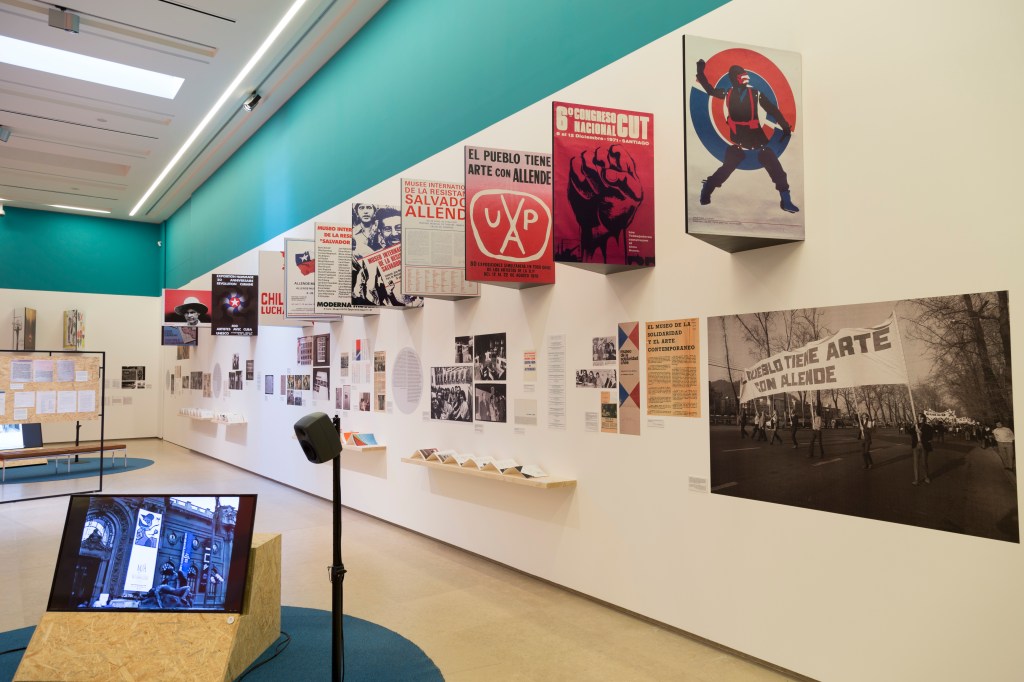
KK: Maybe we had thought about an exhibition, but could not realize it. The point is that Mari commissioned it and provided us with the concrete opportunity to do it there. We refer to this first edition of the exhibition at the MACBA, which opened in 2015, as “the mother exhibition” or the “version 1.0”. The exhibition forced us to pause the research, because we had to produce other forms of outputs. After the invitation from the MACBA, we were invited to do the exhibition at the Haus der Kulturen der Welt (HKW) in Berlin, and we adapted it to that context. Every edition of the exhibition is an adaptation that takes into consideration what might be specifically significant locally, to the histories of where the exhibition is hosted. The core materials are there, but some themes, or questions, are more accentuated while others become more secondary. The exhibitions did not contain original artwork, everything on display is a facsimile of an archival document, photograph, publication, in addition there are wall text and videos that tell the stories. The videos are made from archival material, voice over, archival footage, videos of interviews. For example, for the edition of the exhibition at the Sursock Museum in Beirut, it was obvious to give center-stage to the story of the exhibition in solidarity with Palestine that took place in the same city in 1978, and share as much material as possible. At the same time, it was clear that our intention was to place that history in the context of three other collections, the first of which was the struggle against the Pinochet dictatorship in Chile. In contrast, for the edition of Past Disquiet at the Museum of Solidarity Salvador Allende in Santiago de Chile, we amplified the story of the International Resistance Museum for Salvador Allende, that took place outside the country, when the Chilean protagonists who were involved in it were in exile. Our hosts at the HKW provided the resources and opportunity to conduct research in Germany and expand that chapter of our inquest. The findings were presented in Berlin. In Chile, the MSSA provided funds and support to conduct research in Nicaragua, in addition to facilitating access to their archives. Every edition of Past Disquiet is the outcome of accumulated research, and the most recent edition is the most fleshed out or complete.
RS: The idea of organizing a documentary and archival exhibition is not commonplace to museums of modern or contemporary art. When we were conceiving the “version 1.0” at the MACBA, we needed documents and photographs. We contacted several people asking whether they had such materials and if they allowed us to copy it, reproduce it. Several people were reluctant, because our intention was unusual and confusing. After the exhibition at the MACBA was publicized, they changed their mind and sent us the copies we had requested.
KK: Or they even went back to digging through their archives to find new materials and send them to us.
RS: Indeed, each edition of Past Disquiet gave us more access, credibility, trust and a wider engagement. In 2018, when we were preparing for the edition in Santiago, due to open in April, and we were also thinking about the edition that was going to follow a few months later in Beirut, due to open in July. One of the French artists who had been the prime mover behind the Artists Against Apartheid collection, and whom we had interviewed repeatedly, who was extremely kind, forthcoming and generous, contacted us out of the blue to inform us that he had found the archive of documents we had asked him about a few years earlier. It was too late for the edition at the MSSA, but we certainly included them in the exhibition at the Sursock Museum in Beirut. To answer your question around the next steps today. We were very privileged to receive all the invitations and to be able to conceive and stage all these editions of this exhibition. The year 2018 was especially challenging because we presented two different editions in the same year and we also published the book. And we emerged from that year with an exceptional sense of gratification but also exhausted. Furthermore, while institutional hosts were always generous, but each had their budgetary limitations, and in reality the most “sustained” sponsors of our endeavor were the two of us, we carried the project for ten years, we put our heart and soul into it and invested our own financial resources. In reality, the exhibition format is heavy financially, it’s beautiful and magical, but nonetheless a drain on our resources. After 2018, we were ready to stop the research, and this was important, because we are both compulsive researchers.
KK: I would add that we were ready to stop researching “actively”, apply for grants, traveling, interviewing people…
RS: and following threads. We felt it was important to think about the aftermath and closure. When and how does a project like this end? We went back to our initial motivation that led us into this research, basically to make visible unwritten, or unknown histories and to compensate for the absence of archival sources. Past Disquiet generated its own archive, it collected documents, images, posters, catalogues etc. How do we share it with the public to ensure transmission?
KK: We have to actively make sure that these histories remain visible and are available. The format of an exhibition is time based, it is documented, but there are limitations to how accessible it can be simply from documentary traces. Each edition of Past Disquiet produced a modest exhibition guide, there has yet to be a catalogue. We were lucky to be invited by the Museum of Modern Art in Warsaw to publish our book. The team was initially interested in hosting an edition of Past Disquiet, but due to logistical and financial restrictions, it could not happen. Instead, the team proposed to support a new phase of the research in Poland and the production of a book.
The book is not a replacement for a catalogue, it is intended to access the histories the research investigated and surfaced. We invited scholars and curators to contribute texts and we republished primary sources, including images and documents. We also included a few interviews that were conducted in the context of the research, so the book also serves as a resource. Today, when we think about the future, we want to make sure that these histories and stories are available but we also don’t want to present them outside their contexts. What we have is a researchers’ archive. As we look forward, we are looking towards making a film that would communicate these histories. The film format is organic to what we produced and displayed because generally, Past Disquiet includes overall approximately three hours of video. We hope that a film will circulate in networks different from the book. At the same time, we are also hoping to find ways that the digital archive can be made accessible in appropriate ways.
THANK YOU FOR RAISING THIS POINT, I HAVE BEEN MEANING TO ASK YOU HOW YOU INTEND TO SHARE THE MATERIAL THAT YOU HAVE GATHERED BESIDES EXHIBITIONS AND THE DOCUMENTARY. I JUST WOULD LIKE TO GO BACK VERY BRIEFLY TO WHEN YOU SAID THAT YOU WERE ADAPTING THE EXHIBITION TO EVERY INSTITUTION THAT WAS HOSTING IT; AND ASK IF YOU HAVE EVER CONSIDERED, FOR EXAMPLE, INCLUDING ARCHIVAL OR ART PIECES OF THE COLLECTION OF THAT INSTITUTION.
RS: That question arose with every edition, but in the most pressing manner when we were conceiving the edition at the MSSA in Chile, because we were telling the story of the very museum that hosted us. The MSSA had repatriated most of the collections gathered by the different committees in exile (between 1973 and 1990). This said, the research that we conducted was never about the actual fate of the artworks. Our research was about collection practices for the purpose of militancy, alternative museology, networks of solidarity, and artistic practices outside art-specific places. The artworks themselves appear in the research and different exhibitions in different ways. They appear as protagonists that incarnate links between the four different solidarity collections, so not as artworks in and of themselves. From the outset, we had decided against including the artworks into the various editions of Past Disquiet, though that question had come up at every instance. Past Disquiet is a documentary and archival exhibition.
KK: We really thought about all elements in the exhibition as “equal”. The wall texts, facsimiles of archival material and videos are all documents. The videos we produced were not made as artistic videos. If an original artwork were to enter the space of the exhibition, it would have been relegated to the status of document for us, and it was not our intention to impart such a shift. We wanted to avoid that artworks performed either the role of a document, or of a trophy.
RS: We had photographs of artworks.
KK: Exactly. In the videos you see artworks. One of the videos that was invariably central to the conception of each edition of Past Disquiet, shows hands turning the pages of the catalogue of the 1978 exhibition in Beirut, and makes visible the artworks printed on the pages of the catalogue. The artworks appear in a fleeting way of viewing, it was important that their visibility is not static, to underline that they are not accessible necessarily, at least not all of them are because that is their reality, except in the case of the MSSA. The main characters in our stories are not the artworks, but people and practices. We were not hunting down the artworks of these collections. This is not to say that they are not important, of course they are, but their destiny was not the driving motive of our research and they were not the main protagonists in our story.
RS: They were to some extent, but from a different perspective. Past Disquiet was an exhibition of stories told in wall texts and videos and in the documents, which contained shards or bits and pieces of the stories. The videos follow a narrative, and we used testimony from interviews and archival film material to corroborate our version of the story. When we were making them, we were extremely conscious of our being curators and researchers and not artists, meaning that we did not use the aesthetic strategies or sensibilities that an artist would have used. We worked with Vartan Avakian, a film and video editor, who is also an artist, and to give a form and rhythm to each video, taking cues from the elements that make up each video. We avoided projecting an aesthetic subjectivity, the only subjectivity was in the narrative structure of the script, because Past Disquiet provides, our version of history, the one we assume responsibility for as authors. We use our own voices to tell it. We know that this history has many versions, some contested and others paradoxical.
MY FINAL QUESTION IS RELATED TO WHAT YOU ARE SAYING RIGHT NOW. WHAT IS, IN YOUR OPINION, ARCHIVES’ CONTRIBUTION IN RETHINKING HISTORIOGRAPHY OR MUSEOLOGY? HOW COULD PAST DISQUIET BE CONTRIBUTING TO THE WAY WE LOOK AT THOSE HISTORICAL NARRATIVES AND EXPERIENCE THE MUSEUM AND ITS COLLECTION, WHETHER IT IS AN ARCHIVAL OR AN ARTISTIC ONE.
RS: Keep in mind that Past Disquiet was invited by museums, and not by independent or underground art centers, moreover, it was invited by important canon-making institutions: the MACBA, the HKW, the MSSA and Sursock Museum. At the Haus der Kulturen der Welt, Past Disquiet was the opening event of a three-year long program, titled “Kanon Fragen”, or “Interrogating the Canon”. And on that score, I will just raise two points; the first has to do with the prevailing art historical narratives of the 1960s and the 1970s, which determine a migration of the hegemonic “center” after May 1968, from Paris to New York. The capital of art moved to New York, with Warhol, pop art, Lichtenstein, Rauschenberg, etc.. In fact, that shift is not about the influence of artistic practices and movements, it is the shift of the market and of the collectors. Given the question of interrogating the canon, we conducted an interesting exercise for the exhibition’s edition at the HKW. Using a world map, we pinned all the cities where events connected to four solidarity museums that happened in the span from the mid-1960s to the mid-1980s. Of all the exhibitions, artist actions, biennials and other events that intersected the histories of the four collections, there was a single event that took place in New York. Otherwise the pins on the map identify cities like Baghdad, Tokyo, Rome, East Berlin, Belgrade, Casablanca and several others. In other words, Past Disquiet decentered drastically the geography of the “canon”. The second point has to do with museology, the history and missions of museums, given that the four collections that we studied intended to become museums –only one eventually became a museum, the MSSA —, they were effectively collections built from donations by artists, they were administered and organized by artists and by cultural workers completely outside of the market. The MSSA has one of the most exquisite and outstanding collections of modern art in the 20th century, it is a collection of donations, and not the donation of wealthy individual collectors. The collections were built by artists and for a political cause, in spite of and completely outside the market. Moreover, these artists were also political exiles, in today’s terms, they were refugees. Can you imagine in Rome today that refugees organize an exhibition of contemporary art that includes works by paradigmatic artists, that tours all over Europe, maybe also all over the world? It’s unthinkable. Today, refugees, as political agents, are totally disenfranchised, and certainly cannot have access to the universe of contemporary art. The stories of these four collections show that it was possible. Palestinians were stateless, they remained stateless, the Chileans were all in exile. The South African ANC militants were outside of South Africa and still they built collections and dreamed of museums.
KK: Today, it is more and more critical to raise questions around collection provenance in museums around the world. Whether it is encyclopedic museums that are the outcome of colonial plunder, or contemporary art museums often built through structures of capital, wealth and donations of very wealthy individuals, both are in stark contrast to these solidarity museums. These museums tell very different histories and it is more of a collective museum making history practice. That is very different again, from all these other structures. Is that possible today? I don’t know. I think maybe capital has taken over and it seemingly possible, but I think what Past Disquiet humbly can do is try to make available these histories and stories of these individuals, of these practices that were radical, they were collective, they were rooted in strong positions around justice, around support for people and they show how the idea of a museum can be completely rethought in terms of how it comes together. So I think that a hope is that Past Disquiet is able to open up these histories of museums, which have not been properly acknowledged or written into the canon, or into a museological history. Stories deserve to be told whether or not part of traditional systems or traditional cities or the networks that the western art canon promotes.
RS: Our endeavor is not about decentering the western canon in the sense of expanding it to find a place for the “South” in the story of the “North”. With the case of our research in Italy, for instance, a lot of the artists who participated in the exhibitions and donated to the collections, are still alive but they are entirely outside of the canon. When we conducted our research in Rome and Pisa and small towns in Tuscany, there was very little information available. Eventually we did find them and were able to interview them. Thankfully, there are emerging Italian art historians who are writing about that history, but six or seven years ago there were none. The canon only retains the artists that are celebrated in the market system. The artists we were researching were militant artists, who never wanted to integrate into the gallery or market system and basically remain out of it. Therefore, out of the books, out of the narrative, out of the stories, out of the scholarships.
KK: Even some of the artists who are internationally recognized, their militant practice with a number of these institutions or museums also has not been acknowledged: this aspect of their work has not been properly acknowledged in the history of their own practice. So, there is a lot of writing to be done on the level of individual artists, histories and works within their own respective histories.
THANK YOU FOR WHAT YOU SHARED. TO BE CONTINUED THEN…
 CURATORIAL ARCHIVES IN CURATORIAL PRACTICES