FORMAFANTASMA / DISPLAYING THE ARCHIVE
Milano, 2026
Formafantasma is a research-based design studio investigating the ecological, historical, political and social forces shaping the discipline of design today.
Since founding the studio in 2009, Italians Andrea Trimarchi and Simone Farresin have championed the need for value – laden advocacy merged with holistic design thinking. Their aim is to facilitate a deeper understanding of both our natural and built environments and to propose transformative interventions through design and its material, technical, social, and discursive possibilities.
Working from their studio in Milan (Italy) and Rotterdam (The Netherlands), the practice embraces a broad spectrum of typologies and methods, from product design through spatial design, strategic planning and design consultancy. Whether designing to a client’s brief or developing self – initiated projects, the studio applies the same rigorous attention to context, process and detail. As a result, Formafantasma’s entire portfolio is characterised by a coherent visual language and meticulously researched outcomes.
The studio’s prescient insight into the challenges facing design, culture, the environment and society has earned them the patronage of an array of international clients such as: La Biennale, Rijksmuseum, Serpentine Galleries, Triennale, Fondation Cartier, Nasjonalmuseet Oslo, Vitra Design Museum, FAI, Centro Pecci, MAK, MoMA, QATAR Museum, Diriyah Biennale Foundation, Admaf Abu Dhabi, MaXXI, Moderna Museet, Salone del Mobile, Palazzo delle esposizioni, National Gallery of Victoria, Galleria Giustini / Stagetti, Galleria Massimo Minini and Marc Benda among others.
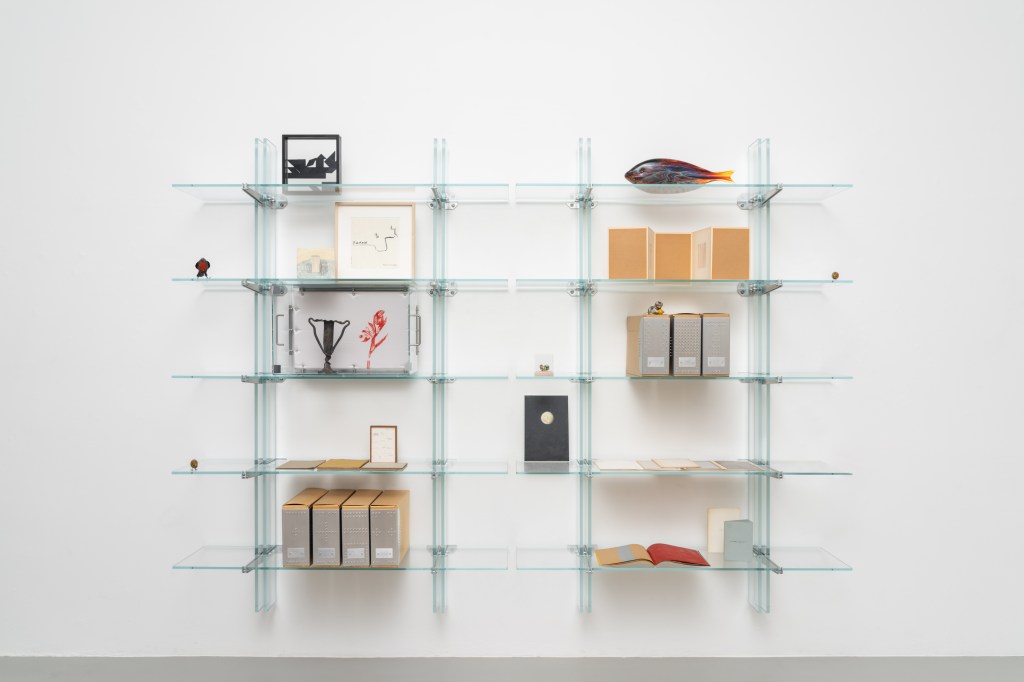
I USUALLY BEGIN THESE CONVERSATIONS WITH THE SAME QUESTION: WHAT DO YOU CONSIDER AN ARCHIVE? AND HOW DOES IT RELATE TO DISPLAY IN YOUR PRACTICE?
Simone: Archives can be interpreted in many ways. A museum collection, for instance, is obviously an archive, but very often what is considered an archive is the accumulation of materials documenting another subject. Archives are not always the final object itself, but rather documentation of an object, which can be a historical event, a piece of work, or the practice of an artist. Often, they are connected to the personal life of an individual. In a simplified sense, an archive is an accumulation of things not yet curated or assigned meaning to. However, archiving can also involve intentionality—deciding what is included and what is excluded. Some items are deliberately placed, while others end up there by chance, as part of a conversation or correspondence. This accumulation and stratification are central to the concept of an archive.
Andrea: For me, there is also a dimension of serendipity in archives—some items are there by choice, others by circumstance, like letters exchanged with a specific person. This stratification and accumulation define the essence of an archive. While a museum collection is intentional, an archive is less so.
Simone: For example, in our project Cambio (2020), we considered a tree itself as an archive. A biological object, such as tree rings or human memory, can function as a form of archiving. Archives are endless in possibility: from memory collections of individuals to orchids that mimic pollinators. There’s a specific orchid that is now nearly extinct. It mimics the sexual organs of a particular female insect to attract male pollinators. In doing so, the orchid “archives” the interaction with these pollinators, preserving traces of a species that is disappearing. This shows how the concept of an archive can extend beyond documents or objects; it can exist in nature in countless ways.
RIGHT, SO YOU DON’T CONSIDER IT AS A STABLE, DEFINED, RIGID SYSTEM. IT’S SOMETHING THAT’S EVOLVING, SOMETHING THAT CAN GROW ORGANICALLY. HOW WOULD YOU DISTINGUISH A COLLECTION FROM AN ARCHIVE?
There is a distinction. Some collections are static, assembled at a specific moment and then frozen. For instance, the ethnographic collection at the Museo delle Civiltà in Rome was created in a defined period and not updated. While technically an archive, it behaves more like a collection. However, we proposed to use it as an archive by reorganizing items by categories—material, year, or other taxonomy—allowing multiple interpretations. Archives are made to ask questions, not just to store objects. Unlike a static collection, an archive is relational, layered, and open-ended. It invites exploration and encourages the viewer—or researcher—to form connections, ask questions, and discover narratives that are not immediately visible.
SO IN A WAY, DISPLAY BECOMES A FORM OF ACTIVATION. WHAT ROLE DOES DISPLAY PLAY IN MAKING ARCHIVES ACCESSIBLE OR INTERPRETABLE?
Display activates archives. Without it, archives remain latent. An archive is engaged only through the gaze of someone else. The arrangement, connections between items, and visitor engagement are crucial. Exhibition design is not just intellectual; it responds to practical realities—handling documents, visitor posture, and circulation. Materials vary in weight, importance, and perception, from facsimiles to original documents. How we present archives affects the way they are experienced, interpreted, and used. The spatial context, the relationship between objects, and the way visitors physically interact with materials all contribute to meaning. Display is both an interpretive tool and a practical necessity.
CAN YOU GIVE AN EXAMPLE OF HOW YOU ENGAGED WITH AN ARCHIVE IN A PROJECT?
Archivio Massimo (2023) in Brescia is a particularly instructive case. We explored multiple ways of interacting with the archive: It is a collection—or rather a stratification—of fragments of a life, including letters, invitation cards, books, documents, and artworks. We designed objects that enabled interaction with the archive not only for visitors, but also for Massimo Minini himself. The objects were also based on his interaction with the space, responding to how he moved, leaned, or sat.
The design was sensitive to different spatial conditions and bodily postures. Leaning over materials, sitting, or standing produces different forms of attention, and these variations were central to the project. In some rooms, materials were placed on the ground, requiring visitors to bend down; in others, tables allowed for a more upright interaction. Objects were designed for openness and interpretive play, allowing Massimo to curate mini-exhibitions or interact with the archive alongside his ongoing projects. The design emphasized narrative elements, printed flowers, screws, and video projections. These shifts created different ways of engaging with the archive.
Over time, it became clear that the project was less about organizing the archive and more about Massimo’s relationship with his own past. The objects were not intended to solve archival problems, but to function as open tools that could be rearranged, reused, and activated over time. They allow Massimo to reorganize, exhibit, or explore his collection, supporting an ongoing, existential engagement with memory and life achievement, while also making visible the fact that archives are never neutral.
HOW DO YOU INCORPORATE NARRATIVE AND LAYERING INTO ARCHIVAL DISPLAY?
Archives provide multiple layers of meaning, often more complex than artworks. They allow juxtaposition, reinterpretation, and create new perspectives on time and history. Archives contain layers—historical, personal, curatorial—that can be rearranged to generate new meanings. Unlike artworks, which are often fixed, archives are dynamic and participatory.
The goal is to create multiplicity: visitors can follow different threads, encounter unexpected juxtapositions, and construct their own understanding of the material.
Projects such as The Disquieted Muses (2022), Archivio Massimo, and Visione Unica (2019) demonstrate this. The Disquieted Muses focused on provocative display, guiding visitor attention with a large amount of documents. Archivio Massimo addressed the existential dimension of archiving, exploring the interaction between Massimo Minini and his archive. In this project, display design also considered how the body engages with the material: different vitrine heights and placements guided visitors’ postures—leaning, crouching, or standing—to create distinct forms of attention and engagement. Visione Unica flattened all archival objects into a single medium (film), allowing a direct comparison between scientific and animistic worldviews while removing the hierarchy imposed by physical materiality.
AND THINKING ABOUT THE POSSIBILITIES THIS OPENS, DO ARCHIVES OFFER MORE FLEXIBILITY THAN ARTWORKS IN EXHIBITION DESIGN?
Absolutely. Archives allow experimentation with space, engagement, and temporality. They invite interaction, discussion, and prolonged attention, unlike artworks, which often assume contemplation from a distance. Exhibiting archives is also deeply connected to time and perception: it’s not just about seeing objects, but about how long you spend with them, how you apprehend them, and how this temporal engagement shapes your understanding. Unlike artworks, archives often challenge conventional display—they might require looking down at a table, handling documents, or studying material that isn’t presented vertically.
In practice, archives demand communal and flexible approaches. Tables function as spaces for discussion, seating arrangements allow study, and lighting can create intimacy, more like a library than a museum. Benches alone are insufficient, because the archive requires active engagement, a different kind of attention, and opportunities to dwell, explore, and converse. This flexibility opens multiple ways of interacting with objects and narratives, supporting both individual and collective experiences.
Museums are often too codified: only private collectors are imagined to sit comfortably among artworks, while the general public endures rigid seating and formal postures. Archives, on the other hand, invite gathering, conversation, and a more dynamic, participatory mode of engagement. They allow visitors to interact with material, to create connections, and to spend time in ways that are both exploratory and reflective, bridging the contemplative and the practical.
WHAT ABOUT CREATING A MORE INTIMATE ENCOUNTER WITH THE MATERIAL? HOW CAN ARCHIVES FOSTER INTIMACY IN MUSEUMS?
Archives are less codified and come with fewer preconceptions about display, which allows for intimate, personal experiences even within public institutions. Unlike most traditional gallery presentations that manage visitor flow and observation distance, archival formats can offer spaces where visitors move at their own pace, sit, read, converse, or even linger.
For example, in our proposal for the Louvre and the Mona Lisa, we imagined a model where the artwork could be experienced collectively, but also in moments of solitude—such as private viewing at three in the morning. For just two minutes, a visitor could encounter the painting alone, creating a private, almost sacred connection with one of the world’s most famous artworks. The space itself was designed to breathe with this concept: grand, arena-like galleries in the morning, transforming into intimate, focused areas for personal encounters at night.
This idea mirrors the potential of archives: they do not demand passive observation but invite participation, discovery, and personal interpretation. Visitors engage with objects, make connections, and find meaning that is uniquely theirs. Archives can therefore cultivate relationships with material that go far beyond the formal, codified experience of a typical museum.
Institutions often resist intimacy, citing conservation, safety, or protocol—but this creates a cultural constraint. Yet moments of intimacy do exist in museums, often inadvertently: when children sit on the floor and draw in front of paintings, for instance, they break open a latent world of possibility, challenging the rigid norms of museum engagement. Historically, some museum departments had small, intimate spaces with seating by low windows, allowing visitors to pause and reflect—a model that contemporary museums rarely replicate. Archives, by contrast, naturally invite this kind of exploration, creating environments where attention, movement, and bodily engagement can be flexible and personal, offering a new vocabulary for how people experience objects, narratives, and space.
THIS BRINGS US TO THE IMPORTANCE OF STORIES AND PERSONAL ACCOUNTS. WHAT IS THE ROLE OF ORAL HISTORIES AND ANECDOTES IN ARCHIVES?
Stories told by archivists are as vital as the physical objects themselves. Archives carry a unique aura and open up possibilities precisely because there is no fixed script: the artist rarely dictates how materials should be displayed, and curators often face the same uncertainty. This ambiguity allows archives to become spaces of interpretation, experimentation, and personal encounter.
Archivists play a central role in this process. Through their knowledge, anecdotes, and contextual explanations, they transform the archive from a static collection into a living, interactive experience. Their stories reveal provenance, hidden connections, and subtle histories behind objects, providing layers of meaning that cannot be captured solely through documentation. Handling objects carefully, sharing insights, and performing small gestures—like opening boxes or pointing out details—creates a proximity and intimacy between visitor, object, and archive that is absent in conventional museum displays.
Anecdotes, far from being trivial, weave meaning and connect fragments of history. Yet institutions frequently neglect oral histories, favouring linear, official narratives over subjective or anecdotal stories. This oversight represents a lost potential: archives could become more dynamic, participatory, and intimate if these stories were treated as integral components, recorded and preserved alongside objects.
Across Italy, initiatives like the Archivio Sonoro, and practices of directors like Pasolini—who collected oral stories and anecdotes as part of cultural memory—demonstrate the transformative power of these narratives. They remind us that the archive is not only what is kept, but also what is remembered, told, and shared. Changing institutional behaviour to recognize the value of oral histories could profoundly reshape how archives are experienced, rendering them spaces where objects, people, and stories converge into a richer, living whole.
I’M ALSO THINKING OF CASES WHERE THE BOUNDARY BETWEEN CURATOR AND ARCHIVIST BECOMES BLURRED. ONE OF THE FIRST EXAMPLES I ENCOUNTERED WAS DIANA FRANSSEN AT THE VAN ABBEMUSEUM IN EINDHOVEN. SHE BEGAN AS AN ARCHIVIST AND LATER BECAME A CURATOR OF THE ARCHIVE, PARTICIPATING IN CURATORIAL MEETINGS ACROSS THE MUSEUM’S SECTIONS. THIS SHIFT CHANGED THE WAY THE ARCHIVE WAS DISPLAYED, PLACING IT AT THE VERY CORE OF THE EXHIBITION. DIANA, WHO WAS NOT A DESIGNER, CONTRIBUTED PROFOUNDLY IN A SIMPLE, YET TRANSFORMATIVE WAY. HER APPROACH SERVES AS A MAJOR CASE STUDY—THE INTEGRATION OF THE ARCHIVE RESHAPED THE EXHIBITION ENTIRELY.
WHAT ARE YOUR FUTURE PERSPECTIVES ON WORKING WITH ARCHIVES?
We are increasingly interested in exploring permanent archival projects, rather than focusing solely on temporary exhibitions. Archives are not fixed containers; they are evolving entities that grow, invite contributions, and foster participatory engagement over time. They are ongoing processes that shape how material is seen, felt, and culturally reimagined. This perspective encourages experimentation beyond conventional exhibition frameworks, inviting new challenges, fresh interpretations, and long-term engagement with the collections themselves.
At the same time, our practice should evolve: the design of temporary exhibitions will continue, but with a more selective approach, allowing us to focus on projects that push boundaries, explore archives deeply, and engage audiences in meaningful, enduring ways.
 CURATORIAL ARCHIVES IN CURATORIAL PRACTICES