FERRAN BARENBLIT
THE INBOX ARCHIVE
Barcelona, 2017
Ferran Barenblit is an independent curator and visiting professor at the University of Michigan, Ann Arbor (since 2021), continuing to organize international exhibitions and biennials. From 2015 to 2021, he was director of MACBA – Museu d’Art Contemporani de Barcelona. Previously, he led CA2M – Centro de Arte Dos de Mayo, Comunidad de Madrid (2008–2015), where he developed an extensive program of exhibitions, education activities, and publications. From 2002 to 2008, he was the director of the Centre d’Art Santa Mònica in Barcelona, working with a number of Spanish and international contemporary artists, including Christian Jankowski and Ester Partegàs. He has twice curated Espai 13 at the Fundació Joan Miró (1996-98, 2000-1), and from 1994 to 1996, was an assistant curator at the New Museum, New York. Barenblit’s freelance curating includes the international exhibitions Standards of Reality (Otis College of Art & Design, Los Angeles, 2005), and Irony (Fundació Juan Miró, Barcelona, 2001).
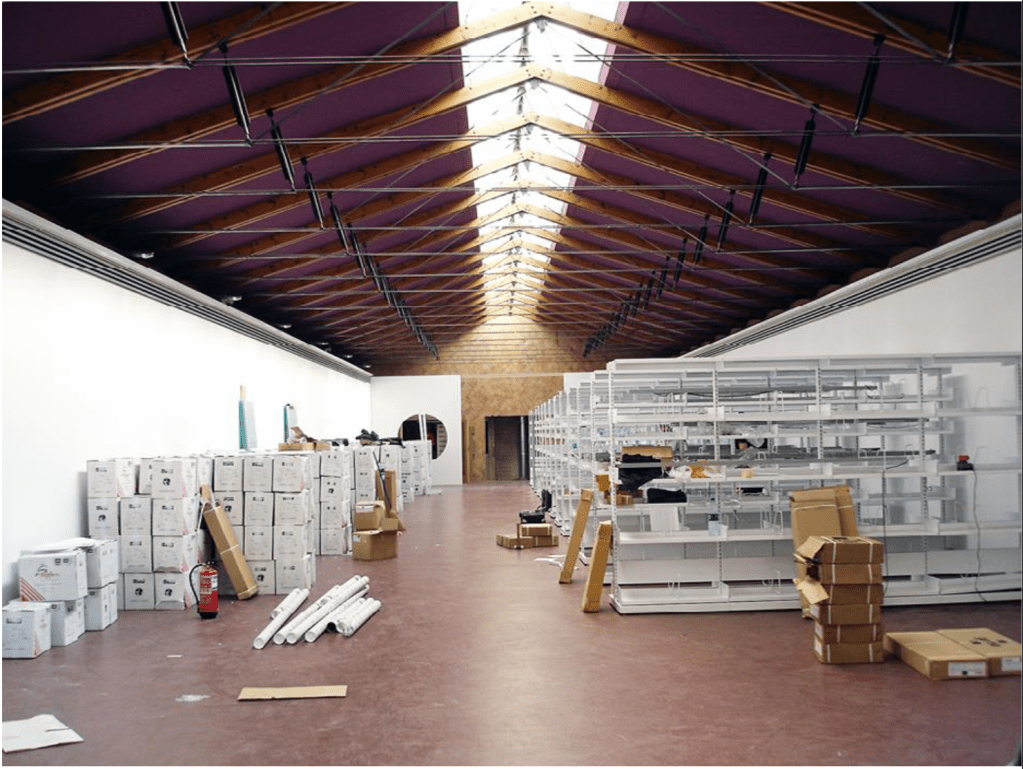
Museu d’Art Contemporani de Barcelona /
Courtesy Museu d’Art Contemporani de Barcelona (MACBA)
WHAT IS THE ROLE OF THE ARCHIVE IN MACBA, AND WHAT IS YOUR VIEW OF IT?
The archive was conceived ten years ago as a repository for everything that was not part of the collection but needed to be kept. That is my understanding at least: if you have the piece, then you need the document; the two are linked. That is the very beginning of the archive. The document helps to contextualize the work in the collection, but this is not its only role: it is also a space for understanding, it can add layers of knowledge that the work of art cannot contain—history, memory, testimonies, and circumstances. Therefore the archive is mainly to keep everything that’s needed to retrace history and go back to the conditions in which art content was created and operated. Unfortunately, this has also generated a kind of fetishism evident within the art market. Only fifteen years ago no one would have paid to acquire a document. Now, owning the document has become very important.
IS AN ARCHIVE A KIND OF COLLECTION IN YOUR OPINION?
There is a big difference between an archive and a collection. In a collection, every single item that is acquired has to make sense in terms of the whole. Sometimes works are not acquired in order to keep the balance of the collection. I don’t think that this could happen with an archive. The bigger the archive, the better it is.
YOU UNDERSTAND THE ARCHIVE AS A PLACE WHERE HISTORY IS KEPT, NOT AS A PLACE WHERE CONFLICT OR TENSIONS CAN EMERGE. AM I RIGHT?
Conflicts do emerge, but only when you have enough archived material. They can appear afterwards, but this is much more related to the research based on it, to the uses that an archive may have more than to its very essence.
DO YOU SEE THE ARCHIVE OPERATING AS A SYSTEM WHERE ITEMS WORK TOGETHER?
For me that is a collection, not an archive. A collection is a system where the action of adding an artwork or object can change the meaning and reading of other items. As far as I’m aware, that doesn’t happen with an archive, but maybe I am wrong. My thinking is pre-fetishization: the nature of archives is not as delicate as that of collections.
WHAT IS THE ROLE OF THE ARCHIVE THEN?
The archive is at the very center of the museum’s mission. It is related to a very precise geographical and temporal context and gives deeper understanding not only of how art was and is produced, but also of how it was imagined, received by the community and the critics from a historical point of view.
AS A DIRECTOR, ARE YOU INVOLVED IN THE DIALOGUE CONCERNING THE ARCHIVE AND THE VISION BEHIND ACQUISITIONS RELATED TO IT?
When we are offered donations to the archive, yes, I am; otherwise, the most important decisions in these cases concern more technical and historical arguments. We are in a very important moment now. We will be acquiring paper documents for several more decades; then, donations and acquisitions to our archive will be digital. We will save a lot of resources as a result of the digitization process. I think that the most interesting thing that we produce today is correspondence, and we make that in digital format.
HOW DO YOU INTEND TO OPEN MACBA’S ARCHIVE TO THE PUBLIC?
I think we can do it in many ways. We can display documents in archival exhibitions, on the ground floor of MACBA’s Study Center; or within exhibitions, as we did in the library for Gelatina Dura (2016-17) and for Miserachs Barcelona, (2015- 16) (works by Xavier Miserachs and an exhibition of his archive); or through the documents that are now available digitally. But in the end the problem is that we do not always have permission to show the archives.
WHAT ABOUT ACQUIRING CURATORIAL ARCHIVES? IS THAT APPROPRIATE IN YOUR OPINION, IS IT SOMETHING THAT YOU HAVE THOUGHT ABOUT?
I was very enthusiastic when we were offered Manel Clot’s archive. He is a person of reference for my generation and has left his archives on USB sticks, somewhere between the physical and the digital. We should actually increase that curatorial part of the archive. We will have to think of a method of archiving emails and similar digital documentation.
WHAT ABOUT YOUR PERSONAL ARCHIVE?
I keep all my notebooks, I write one every six months. Otherwise I am not nostalgic, and I am afraid I have no time to archive. Nevertheless, I have backed up all my emails—sent and received—since I had my first email account in 1996. In my previous job, my inbox had only 2 GB of memory; therefore, every six months I had to archive my emails. I no longer need to do this but I continue to organize them according to the sender’s location: all emails are classified by place, not by subject. I still archive once a year, but I also have shortcuts for the daily triage. So yes, my emails are organized. My library is the library of MACBA. Every week we receive books, and most of them I send to MACBA’s library straightaway. In my office I keep what is important for me at the moment. I always read on paper, I do not read ebooks if possible, but this does not make me attached to objects at all.
SO YOU DO THINK THE ARCHIVE IS A PLACE OF THE PAST?
Yes, I do.
DON’T YOU SEE THE ARCHIVE AS A PLACE WHERE THE PRESENT IS AT WORK?
Yes, I do, but the present soon becomes the past.
 CURATORIAL ARCHIVES IN CURATORIAL PRACTICES