CHARLES ESCHE
THE LEFTOVER ARCHIVE
Eindhoven, 2018
Charles Esche, former director of the Van Abbemuseum in Eindhoven (2004–2024), is currently active as an independent curator, writer, and professor of contemporary art and curating at Central Saint Martins College of Art and Design, University of the Arts, London. He is also the editorial director of Afterall Journal and Books based at Central Saint Martins College of Art and Design, University of the Arts, London (1999-). In 2015 he was the co-curator of the Jakarta Biennale, Maju Kena, Mundur Kena: Bertindak Sekarang [Neither Forward nor Back: Acting in the Present]. He co-curated Le Musée Égaré (Toulouse and Oslo, 2016-17); the 31st São Paulo Biennial (2014); It doesn’t always have to be beautiful, unless it’s beautiful (National Art Gallery of Kosovo, 2012); the 6th U3 Triennial of Contemporary Art in Slovenia (Ljubljana, 2010); the 2nd and 3rd Riwaq Biennales (Ramallah, 2007 and 2009); the 9th Istanbul Biennial (2005); and the 4th Gwangju Biennale (2002).
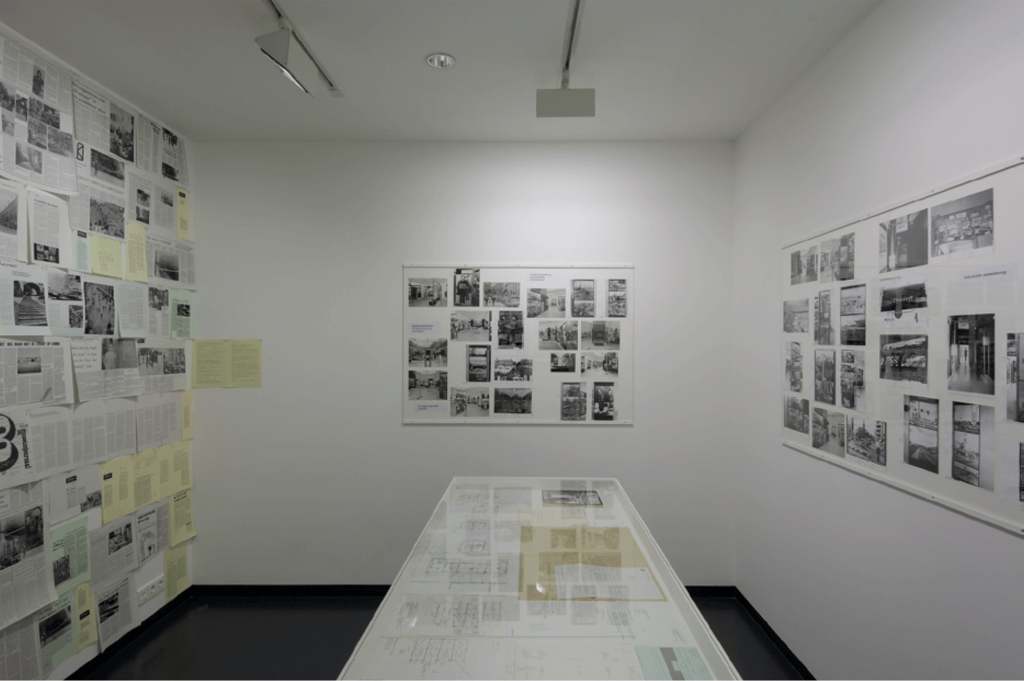
Photo: Peter Cox, 2005
Courtesy Van Abbemuseum, Eindhoven, the Netherlands
WOULD YOU SAY THAT YOUR ARCHIVE IS RELEVANT TO YOUR PRACTICE?
I don’t have an archive really, maybe because I am not that much attached to objects. I have a library of books and a number of photographs that I have taken more or less by chance since I got my first digital camera in 2000 or 2001. I also have certain documents that I have collected almost randomly: some in Edinburgh, others here in the Netherlands. But I have nothing like an archive in a systematic sense at all, and that is probably because I honestly find it presumptuous. I do not think it is necessary for posterity. My archive is in my emails anyway. If someone wants to research it, he/she could go through my emails in the Van Abbemuseum inbox and find everything there. I do not want to self-historicize. This feels to me to be the wrong way to go in curating. I am sure that I could have made better use of the archive in my own practice, but it has never interested me. The pivotal element of curating is how you structurally form the question. If you cannot change the questions that you are asking in each project, then basically you just repeat yourself. In that sense, the archive can also be a limitation, because you adopt things that have worked in the past and apply them in the future. The best challenge is to find the right approach to the conditions in a given context—the environment, the people, the resources. That interests me more than applying a set of criteria coming out of the archive and fitting them into a new situation. I see that I miss some possibilities linked to the archive in doing this—because I cannot make easy connections between the past and the future—but I also find it very liberating.
BUT YOUR BRAIN IS AN ARCHIVE, ISN’T IT?
Yes, and you cannot avoid remembering. But sometimes I try to fight that archive as well. I try not to let my past experiences influence me too much—including not working with artists I know too well. I follow Walter Benjamin’s view of history: that it is not about constructing things the way they really were but picking them up in a moment of danger, as they flash up before you. I like the archive to speak to me from the present through what I randomly remember, organically. This is the most useful way for me: perhaps going through a text I have previously written or a note I took and then letting something pop out suddenly because of its relevance to the way I am thinking today. It’s better than keeping tight narratives of my past—to be honest Google is as good as any archive in this regard. Of course, allowing material to flash up as in Benjamin’s “moment of danger” is against traditional (art) history, and it is only one way to work. My use of the archive is therefore organic and undisciplined, which is 50% good, 50% bad.
DO YOU APPLY THE SAME DEFINITION TO THE ARCHIVE OF THE VAN ABBEMUSEUM?
Although I am not sure how healthy individual narratives are, conversely I do think that an archive is very important for an institution. A museum is a product of society; it records a social memory, something collective and shared. No one has the right to deprive societies of that. In war, we repeatedly see that one of the conquerors’ first acts is to destroy or steal the archive of an occupied people—from eleventh-century Scotland to twenty-first-century Iraq this pattern repeats. The archive (or memory) of the institution changes the way we understand society, even to the extent of creating society as such, as a resistance to the neo-liberal belief that there are only “individuals and families.” An institutional archive makes us more than those individuals, forces us to contemplate what we share and not only what divides us or sets us in competition. At the Van Abbemuseum, we try to look back to the museum’s own previous exhibitions and to the history of certain social narratives in our region that have touched the museum. From 2005 to 2009, we ran a project called Living Archive, where we looked directly at the archive of the museum and its relation to the art world and to political and economic events. I think we were one of the first museums to do that. For instance, we opened up the files of the correspondence between directors and gallerists, to see the extent to which the latter were controlling acquisitions. We looked at issues of ownership, gender balance, whether or not historical changes were reflected in the museum at the time. It was also possible to look at the relationship between artists and the institution itself, for example Hans Haacke refusing to exhibit because he did not want to be associated with Anselm Kiefer, or the museum’s relationship with the City Council and the pressure that democratic politics put on a museum to popularize its policies, and so on. Also, in 2008 we completely reconstructed an exhibition curated by Rudi Fuchs as accurately as we could. I think that was also one of the first times an exhibition was replayed, and it’s a fashion that has since caught on. Learning from our past allowed us to better understand the institution and its present; we were able to integrate the knowledge from the Living Archive into our permanent collection displays after 2012. These things are part of the museum’s history—not the story of its individuals but the way it related to its environment.
WHAT WOULD YOUR DEFINITION OF AN ARCHIVE BE?
The archive is what is left over. An archive can be more or less complete, depending on how much remains and how much has been destroyed. When I first came to Eindhoven, I wanted to know about the period of the Second World War, when the Van Abbemuseum was open and there was a National Socialist government in the Netherlands. There was very little documentation, so we asked people what they remembered. We learnt that the actual archive was probably burned to avoid recriminations, so we had to rely on memory and what survives. Maybe, ironically, that is the best kind of archive! The way our current European society obsessively records everything in image and document is unhealthy. We should leave it to chance and memory. What then survives does so because it remains valuable to the next generation—and what it is lost, remains to be unearthed, speculated about, and constructed again—perhaps incorrectly but according to the needs of the present. And that is OK. There’s a video by Rabih Mroué called The Old House that is very important to me; it talks about how we need to remember that we forget and forget that we remember. The archive can fight against this and can freeze something that would be more useful if it were in movement.
 CURATORIAL ARCHIVES IN CURATORIAL PRACTICES