ABDELLAH KARROUM
THE NON-INSTITUTIONAL ARCHIVE
Rabat, 2017
Abdellah Karroum served as Director of Mathaf: Arab Museum of Modern Art in Doha, Qatar, from 2013 until 2021. He is currently a Special Curatorial Advisor for Qatar Museums and continues to be active as a curator and advisor on institutional and non-institutional art projects worldwide, particularly in the MENA (Middle East and North Africa) region. He is the founder and artistic director of L’appartement 22, an experimental collaborative space for exhibitions and artists’ residencies founded in 2002 in Rabat, Morocco; and of Le Bout Du Monde art expeditions, a long-term project that has taken place in different locations around the globe since 2000. Karroum has organized and co- curated numerous international exhibitions and programs for various institutions including CAPC Musée d’art contemporain de Bordeaux, where he worked from 1993 to 1996; the 2006 DAK’ART Biennial of Contemporary African Art; the 3rd Marrakech Biennale (2009); and the 2012 Biennale Benin. In 2012 he co-curated La Triennale in Paris, Intense Proximity, with Okwui Enwezor. His research and writing on curating and creating art institutions continues through his involvement in institutional and non-institutional projects worldwide and more specifically in the MENA (Middle East and North Africa) region.
LET’S START WITH A STRAIGHTFORWARD QUESTION: WHAT IS YOUR DEFINITION OF AN ARCHIVE?
For curatorial archives, it is the physical or digital information that connects me with the memory of the art experience, of production, display, and context. In the case of L’appartement 22, the archive is a tool to share its history and, through it, understand art and how it is made at certain moments and locations. It is also a kind of index, a personal system connecting different ideas, realized and not yet realized.
HOW DID L’APPARTEMENT 22’S ARCHIVE DEVELOP AND WHAT IS ITS FUTURE?
L’appartement 22 is not an institution, but a place that enables the production of artistic projects. It comes from a need to create and produce experiences. To experience art we need something to be physically present. For me, the first stage is always to look at the artist’s archive, to know about his/her projects, to connect this memory to the current situation, and therefore understand what can be made, using our knowledge of the past in the present.
The archives that we have at L’appartement 22 predate our own work with the artist; they actually come from his/her studio and from previous experiences. A studio visit always involves the curator looking at traces produced by the artist, with a view to sharing this production through methodologies that can keep the initial idea clear and solid until it reaches the viewer in an exhibition or a book. As a curator, you help an artist to create something new. The information in the archive does not necessarily reflect the real experience, but offers key elements for understanding it.
WHY DO WE NEED TO KEEP DOCUMENTATION ABOUT SOMETHING THAT IS EPHEMERAL AND TRANSIENT LIKE AN EXHIBITION?
I think that what remains is important for two reasons: to expand the action beyond the place where it happened, and to extend it into the future. Projects need to be available; they have to have the capacity to be reactivated by others in the future for example, to exist in a space that is larger. L’appartement 22’s projects are proposals for society and its potential change, so their effectiveness is not immediate. Every project has to be active for a long time to actually reveal its true potential. The project is a starting point; it develops over time. But this is possible only if we retain the memory of how the action first took place—the archives of L’appartement 22 were built up in this way. In order to do that, you have to create something physical and publicly available. I need to see something that exists on paper, and that it is made of presence and absence at the same time. We want to share information on how things happened, also because we do not have a publication very often after the project. At L’appartement 22, we work with a number of young artists who likewise have no publications; therefore, it is important to have documentation on them and to share this with professionals and the wider public. In a way, I would say that I owe the initiative of opening L’appartement 22 to younger artists; it was a way of creating an independent space that was devoted to their promotion. The encounters I had and the quality of projects I came across made me decide on creating this much-needed space in 2002. I wanted to share those expressions of beauty with audiences. I had no specific reference in terms of creating an institution; the idea was to fill a gap in the cultural landscape. We need to keep in mind that at the time Morocco was in the first years of its strategy of political transition. From the 1980s onwards, the country was officially represented in international exhibitions, but only established artists of the older generation were included; younger artists had no space within the powerful system of influence—probably due to the fact that the Makhzen, the government, had been fighting student movements and new ideas for decades. In the 1960s, Moroccan artists were of course traveling, and they also had their own intellectual network (as, for example, Mohammed Melehi in Mexico being invited by Mathias Goeritz to make a public sculpture).
Sometimes I share this documentation with my colleagues. The majority of exhibitions that I have curated internationally have involved collaboration with other professionals, in order to verify the relevance of a project through discussion and confrontation.
TELL ME ABOUT YOUR PERSONAL PROCESS OF ARCHIVING, YOUR NOTEBOOKS FOR EXAMPLE.
Every project starts with a note. Even the notebook I often used for L’appartement 22 is part of the White Book Project that started with me taking notes, which I still have somewhere in the archive, because I wanted to remember the initial idea and the first layout. Then some other versi- ons and rewritings made sense to me, but they needed to be edited before being made public. When you write something, it is already public. You know that you cannot control it; it no longer belongs to you. If you write it, it is to read it again in the future, because otherwise you would forget it: you are not going to stay the same person but evolve over time. I do not like to write down my speeches and talks for example, because I will never speak the same, but I do take notes to help me in the future to use the past, even with a new approach to it.
DO YOU GO BACK TO YOUR NOTES THEN?
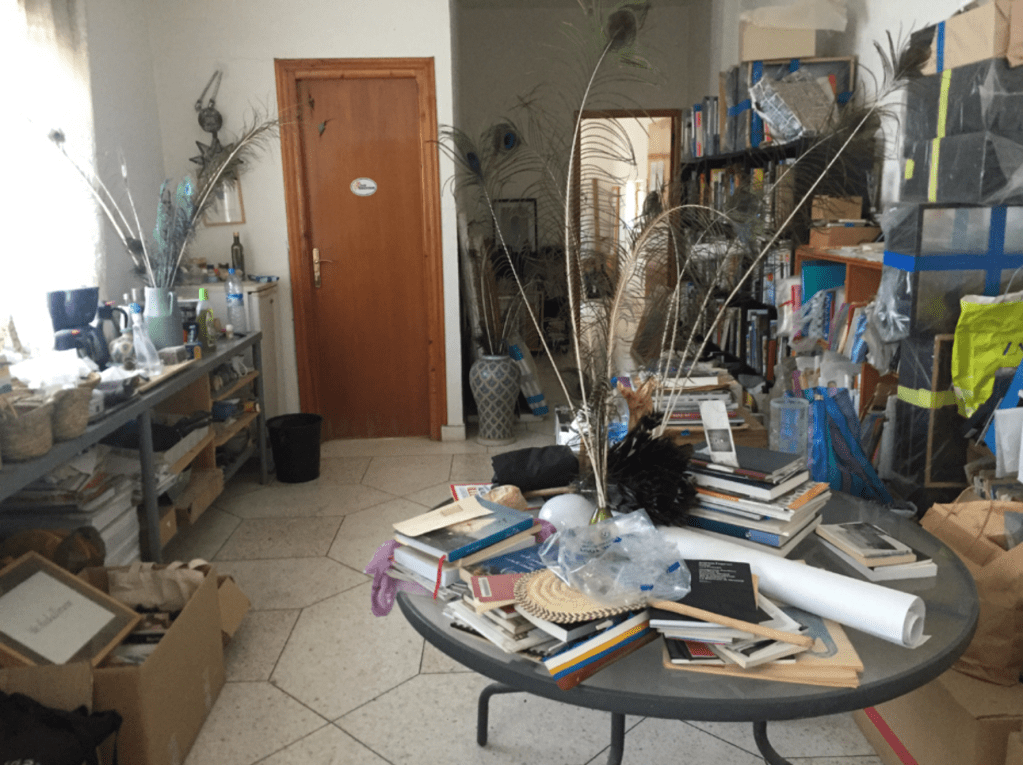
Definitely. This is why I need to go to Fez and spend some time in my office, where all my books and archives are. I usually do that when I am com- missioned to write a text, it is a construction site, a chantier. I edit the text written in the notebook to complete the idea, explain it, give examples, and once it is entered into the book, I make a reference in the notebook, and if it is published, I erase it. Publication is the validation of a num- ber of ideas. Publications are collectable objects, and they are made of statements. What stays in the notebooks are the leftovers, but also parts of a discourse that I still have to make, and they are waiting to be used somehow. Sometimes I take notes to help me take better notes in the future. Sometimes it is to help me remember ideas. Or it is just for myself, if I know that something is never going to be published as it is.
WHAT DO YOU NOT WRITE ABOUT?
I don’t always write. Sometimes I use the pho- ne, and I lose a lot of stuff by changing my phone and external drives. I have not been writing much by hand recently—for sure I have a lot of notes in my phone now or on social media platforms. I don’t know how effective they are or even if they make an impact. Everybody can instrumentalize them, if they are not official, which is often the case with social media—look what has happened with protests in northern Morocco and how the machine of power has manipulated very strong messages from bloggers around the country1. You can do nothing about that. The only thing that you can do is not to write on social media, but create an actual text and publish it on more reliable platforms. The publication L’appartement 22 (2002-2008) for example, was not written in book format, but was instead an edited collection that used notes as the basis for documenting my story of a place I created as a curatorial laboratory. I intentionally did not want to write a literary narrative, but I very much wanted to publish texts as they were drafted at the moment of encounters and as they were shared with audiences digitally, in posters and on the walls of exhibitions at L’appartement 22. My intention was to offer the original reading format of the curatorial idea, with enough effort given to connecting the artists’ expression and the viewers’ experience of reading.
FOOTNOTE
- This interview took place when there were many other examples of appropriation of user information by Facebook (and other platforms) during the American presidential election (2016), and the United Kingdom European Union membership referendum (2016). ↩︎
 CURATORIAL ARCHIVES IN CURATORIAL PRACTICES